The Traditional Lineage-Based Learning Model vs. a Modern à la Carte Approach to Knowledge Collection
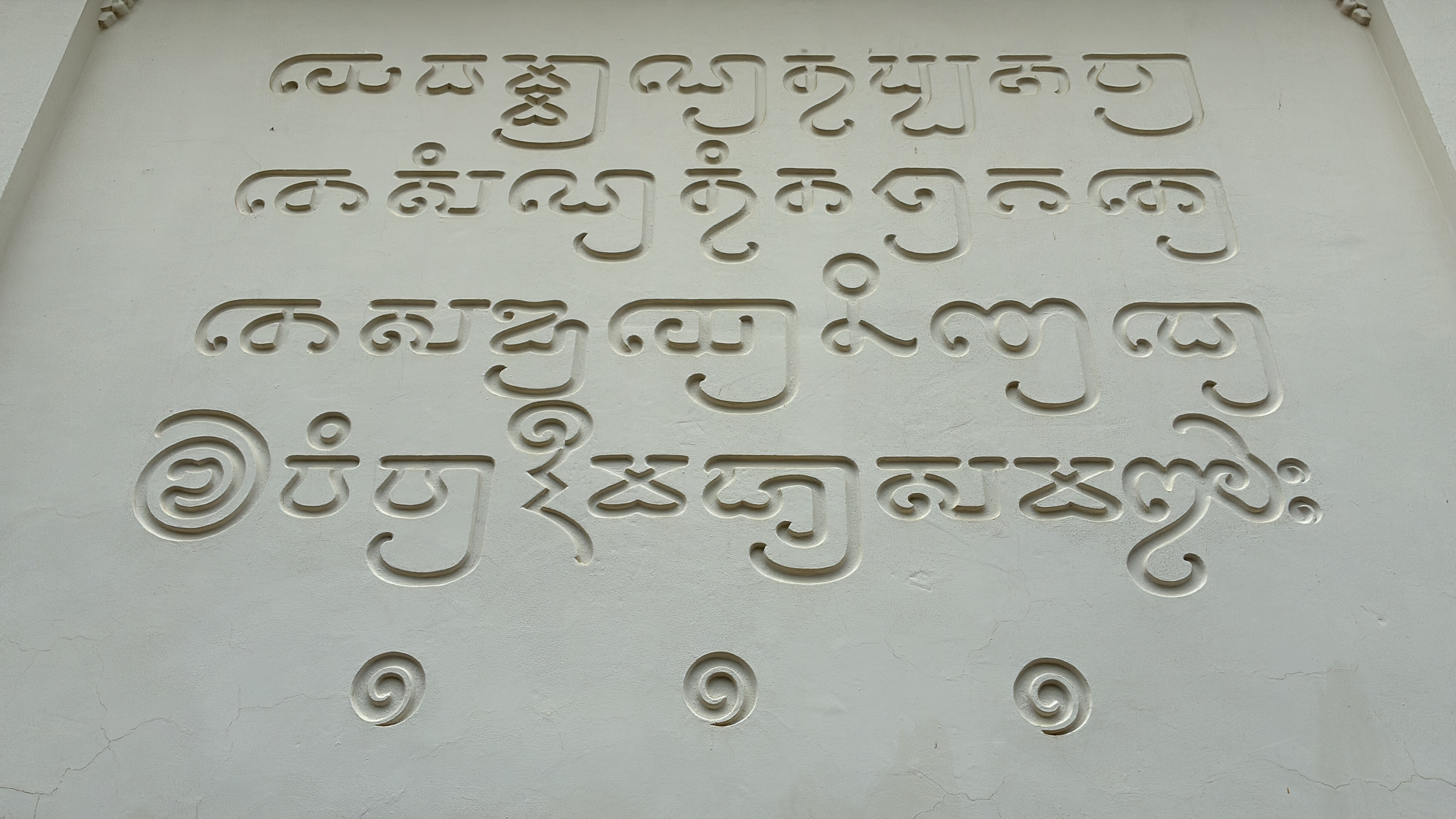
Ye dhamma formula in pallava script
Introduction
When the student is ready, the teacher will appear. This age-old expression originating from traditional learning systems is used often. But, often misunderstood in modern learning systems, the saying evokes the idea of an epiphany or of being at the right place at the right time.
This modern interpretation can overlook the intentional and active preparation a student undertakes in order to become fit to receive the teachings in a traditional learning model. A student’s readiness is sometimes described as being an empty vessel—one that is turned upright, intact and empty. Open and receptive, this vessel is ready to listen with full attention and to be guided by the teachings.
In the traditional teaching, The Three Defects of the Vessel, the qualities that inhibit learning are discussed for the purpose of offering an opportunity to recognize and correct behaviors that prohibit learning, assimilating and applying the teachings effectively. (2,4)
An overturned vessel is distracted and lets their attention wander away from the information being presented. Knowledge poured onto the overturned vessel is not captured, but runs down the sides. (2,4)
If the vessel is broken or cracked, it will leak and cannot retain anything long-term, no matter how much or how often teachings are poured into it. The learning cannot be put into practice. (2,4)
When the vessel contains poison, the student is bringing the wrong attitude to learning. In this case, the teachings cannot benefit the student and instead become convoluted with motivations and ideas fueled by delusion, greed, anger, arrogance, envy, and more. (2,4)
In the modern learning model, knowledge is often pursued for these very same motivations that traditional knowledge considers to be poisonous. Both teachers and learners allow themselves to take any aspect of the knowledge that they like, enjoy or deem “valid” from various traditional systems, cultures, subjects or practices—such as medicine, meditation, yoga and other practice-based traditions—and discard the rest as superfluous, without purpose or credibility.
This may stem from another common idea in the modern learning model: that a teaching or a technique belongs to the learner simply because they were exposed to it, especially if one has paid to take a class. In these cases, the information that has been preserved in a lineage becomes nothing more than a commodity to obtain and use, very often for material gain, for fame or for praise.
In cases like these, from the perspective of traditional teachings, many modern learners may resemble the upside down cup, the cracked cup, or the poisoned cup; all are unable to respectfully obtain knowledge and carry out the responsibility that comes with upholding knowledge.
Traditional Learning Model
Transmission of knowledge from a practitioner to a student preserves traditional knowledge and associated practices. This is how information has been passed down for generations, long before the modern technologies of mass produced books on the printing press, electronic recordings and the internet were available. For most of human history, traditions have been passed down orally and through apprenticeship, forming a lineage. When a lineage maintains the continuity of this process, it is considered unbroken.
A traditional learning model requires three things for the transmission and preservation of knowledge:
A body of knowledge
Oral explanations
Practical realization of living practitioners
Within the traditional learning model, there are three stages of learning:
Listening, or gaining intellectual knowledge (1)
—Recording and memorizing exactly what is presented
—Questions to clarify what was heardContemplation, or reflecting to personalize the knowledge (1)
—Checking for correct understanding
—Questions about comprehension and ability to applyPractice, or applying and integrating knowledge (1)
—Repeating exactly what was heard and comprehended
—Questions about the experience of that application
Initially, a student simply listens to the information, working to absorb and memorize the information. Even in modern times, this is generally how young children learn to read and write, first memorizing the alphabet and the sounds of each letter. In this first phase, they must grasp the building blocks of language that will allow future understanding when the letters are placed in certain arrangements to form words.
Eventually, the student will recognize the sounds of the letters in the words they speak and hear. In this second stage, children are contemplating and reflecting on what they learned and personalizing it. They are not yet reading or writing.
As understanding deepens, the application comes naturally. Children can start to read and write by sounding the letters out. Over time, and with help from their teachers to correct any errors in their reasoning, their recognition leads to a greater ability to apply their learning experientially, which leads to realization, or a full integration of the knowledge into daily life and practice.
One of the important parts in this process, which is not so common in modern learning systems, is the process of continuing to check understanding with a teacher who can guide a student in applying knowledge and in clarifying understanding on a personal level.
The other important part is the practice. While there is a tendency in modern learning to consider a collection of knowledge or a certain level of educational attainment to equal mastery, it does not make a person a practitioner. Rather, a practitioner is someone who can apply knowledge, not just recite information. (3) Practitioners are vital to the traditional learning model, to the accurate preservation of information and to the continuation of a lineage.
Role of a Teacher and of a Student
In a lineage-based traditional learning model, the relationship between a teacher and a student is paramount. Often, the student serves as an apprentice and/or an assistant to their teacher, learning through observation and participation in various activities of the teacher. This follows the path of the stages of learning where initially, a student is observing, then they may ask questions about what they saw or why a certain course of action was taken, etc. Eventually, the student will perform some of the duties and tasks, gradually taking more responsibility for outcomes until they can practice independently.
Even after the student begins to practice independently, their relationship with the teacher continues. The teacher acts as a resource for practice, learning and support and is often regarded as more of a parent figure than what is seen in the modern learning model. Each teacher/student relationship is personal and the teaching is individualized to the needs, interests and ability of the student.
In contrast, in the modern learning model, there is generally a basic curriculum delivered to a potentially large group of students for a set period of time, after which, the students and the teacher may never have contact with one another again. The relationship is not as often personal and the teaching is not as often tailored. In this environment, it is very possible that a student can get through the curriculum without a clear understanding or application of the knowledge they are meant to learn.
Given the intensity of time and level of interaction between the student and the teacher in the traditional learning model, this relationship is not entered into lightly or easily. Both parties must take the time to get to know each other well enough to determine if the fit is good before making a commitment; it is understood that both parties are undertaking a great responsibility to each other in entering the relationship and therefore both must assess the potential well ahead of time.
Before making such a commitment, the student must consider their responsibility to:
Clear up any doubts they may have with the teacher
Always be honest and transparent with the teacher
Maintain respect of and devotion to the teacher, even when encountering their human fallibility
Devotion to the teacher means consistently prioritizing commitment, loyalty, effort and belief. Along these lines, the student is promising to follow the guidance of the teacher, to show respect to the lineage and the knowledge transmitted to them through ethical conduct and to maintain the practices and responsibilities the teacher has designated. If the student is continually doubting, questioning or disrespecting the teacher, they are not able to be guided by that teacher.
A good student will:
Reference how to learn
Take care of the teacher
Help the teacher accomplish what they are trying to accomplish
In the modern method of learning, this level of devotion is hardly seen. In fact, the concept is often disparaged as a mechanism of controlling the student. Ironically, a focus on material gain, fame and praise for oneself often present in the modern learning model orients students toward validation seeking, consumption and accumulating material goods, all of which subconsciously controls thoughts, speech, actions and the trajectory of life.
In the traditional learning model, when a student finds a teacher they can rely on to guide them, the student generally feels a sense of appreciation and of honor in participating in the continuation of a lineage and in the care of one’s teacher.
While there is a certain level of faith required in the traditional method of learning, students are encouraged not to just blindly accept the teachings. Rather, they must examine, contemplate and actively engage in checking the presented knowledge and their understanding of it. This is both for the benefit of the student’s learning and for the benefit of preserving the teachings. (3)
When a teacher takes a student into their practice and lineage, they are essentially taking responsibility for the actions of that student. They remain a person concerned with the well being, conduct and improvement of the student as well as holding responsibility to the lineage for that person’s conduct.
In the traditional learning model, there is no specific pathway or training offered to become a teacher and becoming a teacher is generally not an accepted motivation for learning. Rather, the intention for a student entering a traditional student/teacher relationship is to learn, study and practice.
After many years, if a person becomes a well versed and successful practitioner, younger practitioners and potential students may seek them out to request to learn from them. On rarer occasions, a practitioner’s own teacher might suggest that they share some aspect of their practice and knowledge with others. Unlike the modern learning model, there are no certifications or programs to train teachers as the goal of learning is not for the purpose of teaching others.
A good teacher will have:
Knowledge in the field of study
Good conduct
A clear, intact lineage
Patience
Compassion
Kindness
Their own realization in the field of knowledge
A genuine interest in the improvement of the student
Permission to teach from their own teacher
In the traditional learning model, it is the teacher who has the most to lose by taking on an unprepared student. The student is investing their time and some resources, but the teacher is investing everything: their resources, their reputation, the future of the lineage and the teachings they have devoted themselves to upholding. A high level of trust must be cultivated in the student/teacher relationship in the traditional learning model.
Whereas, in the modern learning model, if a student ends up not liking their teacher or the teachings they have been offered, they might feel free to abandon that teacher or topic at their own discretion. Sometimes, they may feel free to speak harshly about what they have learned or even the teacher themself. This is a byproduct of a lack of commitment and an underdeveloped relationship on the part of both the teacher and the student in the modern learning model, but also a lack of preparation on both parts.
In current times, many of the people who assume the role of teacher are not actually prepared for the responsibility or qualified to be a teacher as described in the previous list of qualities of a good teacher. Stepping into a role one is unprepared for – whether as student or as teacher – diminishes the potential for learning for everyone.
If a teacher is not upholding their responsibilities to a student in the traditional learning model, it may be that the student disengages from the learning with them. However, they still maintain a level of respect and responsibility to the teacher and the teachings.
In traditional learning, the student and practitioner maintain the following minimum daily responsibilities:
Reverence
—Daily practice of respect and gratitude for the teachers, the knowledge and the lineage
—Without the teachers, the student/practitioner would have no knowledgeEthics
—Upholding the 5 precepts
—Cultivating the 4 brahmaviharas or the 4 immeasurablesDiligence
—Continuing to seek teachings, guidance and to study
—Continuing to practice and apply the teachings
The lifelong continuation of seeking guidance and teachings from one’s teacher is another area where the traditional learning model and the modern learning model diverge. Many modern learning systems teach in the context of a time-capped program with a fixed result for every student, such as a certificate, offering the authority to go forth and practice, or even teach, independently.
In the traditional lineage-based learning model, because the relationship is central and unique, there is not necessarily a fixed timeline for learning certain things. Rather, the result is based on the skills demonstrated by the student and their ability to practice. In this sense, the teacher will be the one to determine when a student has mastered a certain skill and is ready to practice independently. Certainly, a student generally does not begin teaching without the blessing and encouragement of their teacher.
Purpose of a Lineage in Traditional Learning
An unbroken lineage keeps knowledge alive and relevant across time and contexts. Its purpose is to preserve knowledge in its original form; this is done through practitioners. Without people continuing to carry out the actions and practices held in a body of knowledge, that knowledge cannot continue. In order for the knowledge to survive, there must be experienced practitioners who can continue to apply it and transmit it, without diluting it. (3)
Being part of this process of upholding practices and the teachings, thereby contributing to the preservation and perpetuation of valuable, useful knowledge, is both an honor and a responsibility. It is a communal effort that is fettered by individualism, consumerism and materialism—in short, when a practitioner is more self-concerned than focused on ethical conduct and upholding the teachings with commitment and discipline.
Self-concern alongside learning and practicing for the purpose of material gain, fame or praise puts a lineage and its teachings in jeopardy of being lost. One may even say that the practitioner is not practicing at all if their focus is on themselves and fulfilling their own desires rather than upholding what has been taught. Rather, a student or practitioner of the traditional learning model treats the knowledge and the lineage as a precious resource and privileged responsibility. And yet, often in the modern learning model, self-concern is the main motivation in undertaking elective education.
Teachings that are passed without connection to a lineage are considered to be diluted, unproven, unsupported and unhelpful. The lineage verifies the teachings and the practice continually with each generation of practitioner, bringing the teachings into a contemporary context. When the teachings are removed from this container, they become unrecognizable, potentially harmful and eventually, useless.
Whenever information is separated from its whole and/or manipulated to fit a system in which it did not develop, concerns of effectiveness and the potential for harm arise. (3) Essentially, when a part is separated from its whole, that part becomes something entirely new, untested and unsupported by the tradition from which it originates. Both systems—new and old—become convoluted and the challenges of preserving the integrity of traditional practices accumulate.
The lineage is a container that holds every tool a practitioner needs to learn, to practice and, eventually, to share with future generations.
References
Encyclopedia of Buddhism. 2026. “Threefold training of listening, reflection and meditation.” https://encyclopediaofbuddhism.org/wiki/Threefold_training_of_listening,_reflection_and_meditation.
Just Dharma. unknown. “The Three Defects When Listening to the Dharma ~ Patrul Rinpoche.”
https://justdharma.org/the-three-defects-when-listening-to-the-dharma-patrul-rinpoche/.Rigpa Shedra. 2018. “Three Wisdoms—An Interview with H.H. Sakya Trizin.”
https://www.rigpawiki.org/index.php?title=Three_Wisdoms%E2%80%94An_Interview_with_H.H._Sakya_Trizin.Samye Institute. 2024. “Three Defects of the Vessel.”
https://www.samyeinstitute.org/wiki/three-defects-of-the-vessel/.